
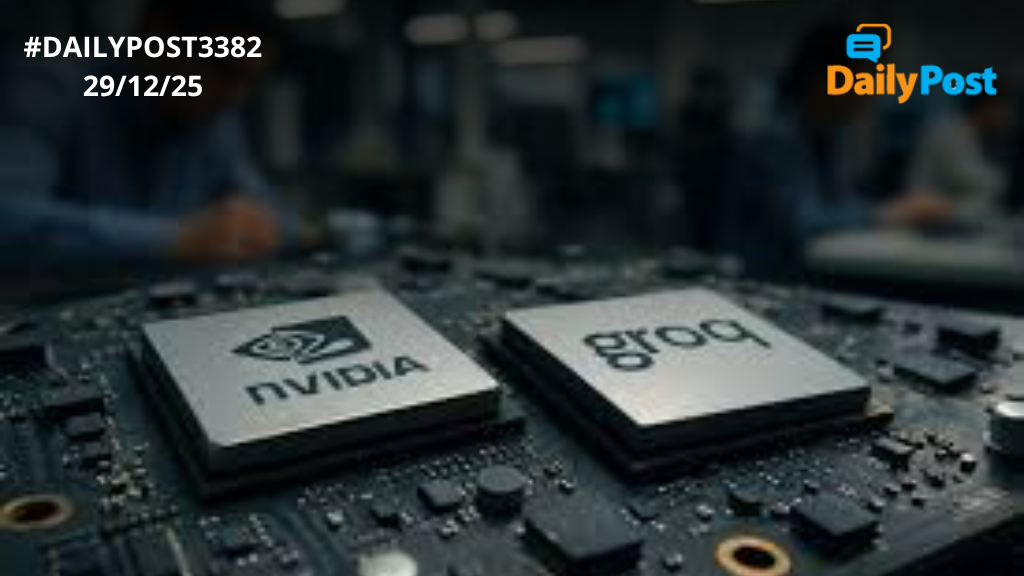
Nvidia has struck a landmark $20 billion non-exclusive licensing deal with AI chip startup Groq for its Language Processing Unit (LPU) technology, which promises 10x faster AI inference at a fraction of GPU energy costs. Groq CEO Jonathan Ross, who pioneered Google’s TPUs, and President Sunny Madra join Nvidia to integrate the tech, while Groq operates independently under new leadership. Valued at $6.9 billion just months ago, this dwarfs Nvidia’s prior $7 billion Mellanox buyout.
For the AI and chip industry, the deal accelerates a shift from training to inference workloads, where low-latency, efficient chips like Groq’s LPUs—using SRAM for sequential LLM processing challenge Nvidia’s GPU dominance. It neutralizes a fast-rising rival amid custom silicon from Google, Amazon, and hyperscalers eroding Nvidia’s lead, signaling intensified battles over real-time AI applications powering chatbots and edge computing.
Nvidia gains critical inference expertise, talent, and IP to embed LPUs into its AI Factory architecture, expanding beyond GPUs for broader workloads while most Groq staff (90%) transition over. This “acqui-hire” structure sidesteps full acquisition scrutiny, bolstering Nvidia’s end-to-end stack from hardware to cloud deployment without equity transfer.
Technically, LPUs offer superior speed for smaller models via rack-scale SRAM (up to 14GB shared), but scaling to massive LLMs remains GPU turf; legally, the non-exclusive license-plus-talent move invites antitrust probes from US/EU regulators eyeing “killer acquisitions” that eliminate competitors. Far from pure monopoly consolidation, it fortifies defenses as inference explodes.
NVIDIA’S INFERENCE CHECKMATE JUST REDEFINED THE CHIP WAR!