
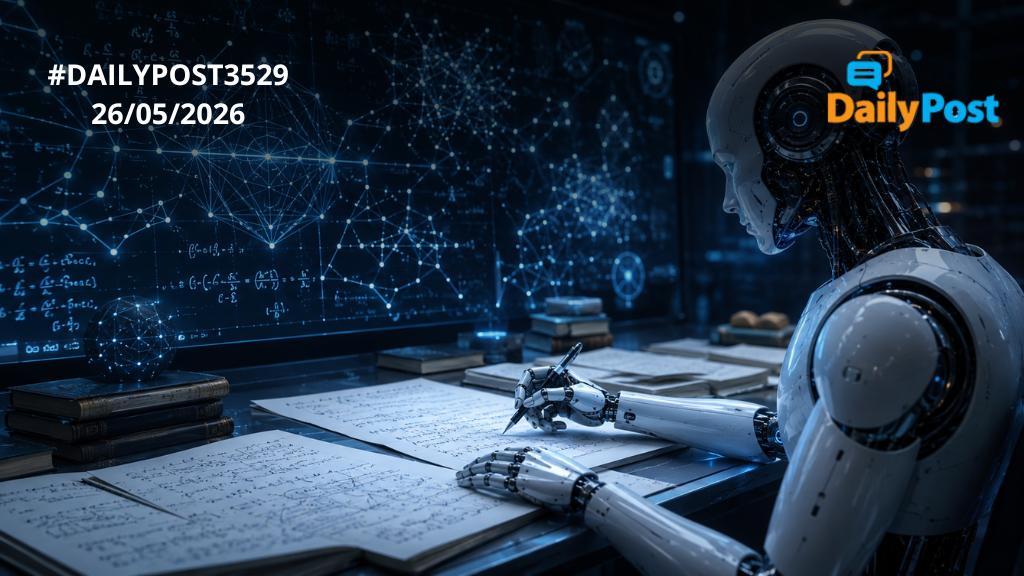
Last week marked a watershed moment in AI mathematics. OpenAI announced on May 20, 2026, that its AI had disproved an 80-year-old Erdős conjecture — the first time AI autonomously cracked a prominent unsolved problem. Days later, Google DeepMind delivered a stunning counterpunch: its AlphaProof Nexus system had solved nine open Erdős problems, including two unsolved for 56 years, at just a few hundred dollars per problem.
Why did these problems resist decades of human brilliance? Erdős problems demand fundamentally new mathematical insights that even coordinated teams of elite mathematicians couldn’t systematically generate. AI’s breakthrough came through formal verification using Lean, pairing language models with proof assistants that generate, test, and validate solutions iteratively until one passes.
Google DeepMind and OpenAI now lead the race, with Gemini 2.5 Pro and o3 models competing across math benchmarks. Both have shifted from raw scaling to “thinking models” using extended reasoning chains. Experts predict AI will tackle Millennium Prize Problems — math’s million-dollar challenges — before 2030.
AlphaProof Nexus also proved 44 open conjectures from the Online Encyclopedia of Integer Sequences, demonstrating scalability humans cannot match. The age of AI-accelerated mathematical discovery has arrived, transforming century-old problems into tractable challenges for algorithms that think and verify at machine speed.
SILICON SOLVED WHAT GENIUS COULDN’T: MATH’S FUTURE IS NOW CODE.
Sanjay Sahay
Have a nice evening.