
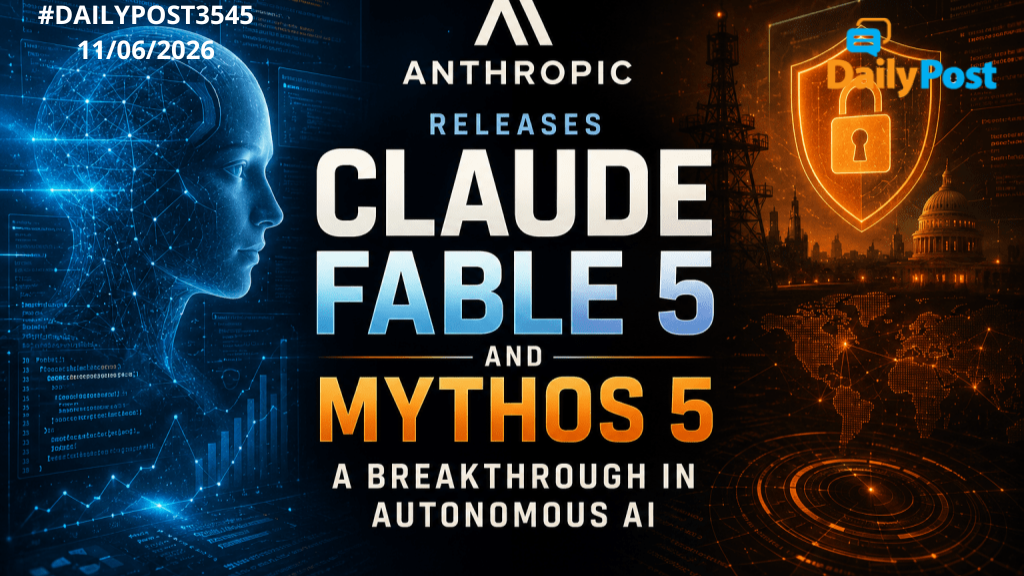
Anthropic has launched Claude Fable 5, the public version of its new Mythos-class AI. In simple terms, this is a very powerful model wrapped in strong safety rules. For most people, it can write code, analyze documents, summarize complex information, and handle long, difficult tasks better than earlier models. But when a request touches risky areas like hacking, exploit development, biology, or chemistry, the model may refuse the task or hand it over to a safer fallback model.
That is the key point: Fable 5 and Mythos 5 are not two different brains. They are the same underlying model, but with different access and guardrails. Anthropic says Fable 5 is for general use, while Mythos 5 is reserved for a small group of cyber defenders and critical infrastructure partners through Project Glasswing. So the public gets the power, but not the full freedom.
What do the benchmarks mean? They show the model is extremely capable at reasoning, coding, knowledge work, and long, multi-step tasks. A model may score well on tests and still fail in messy real-world settings. Does this make the world more cyber secure? Potentially, yes — but only if defenders use it well. The same technology that helps security teams find weaknesses faster can also help bad actors if it is not controlled.
So the current status is this: we are not in a fully secure world, and we are not in an AI-does-everything world either. We are entering a stage where AI can meaningfully assist cybersecurity work, but cannot replace layered defense, human judgment, patching, monitoring, and incident response. The best use of models like Fable 5 is as a force multiplier for defenders, not as a magical shield.
POWERFUL AI IS NOT AUTOMATIC SECURITY, ITS JUST A STRONG BEGINNING.
Sanjay Sahay
Have a nice evening.