
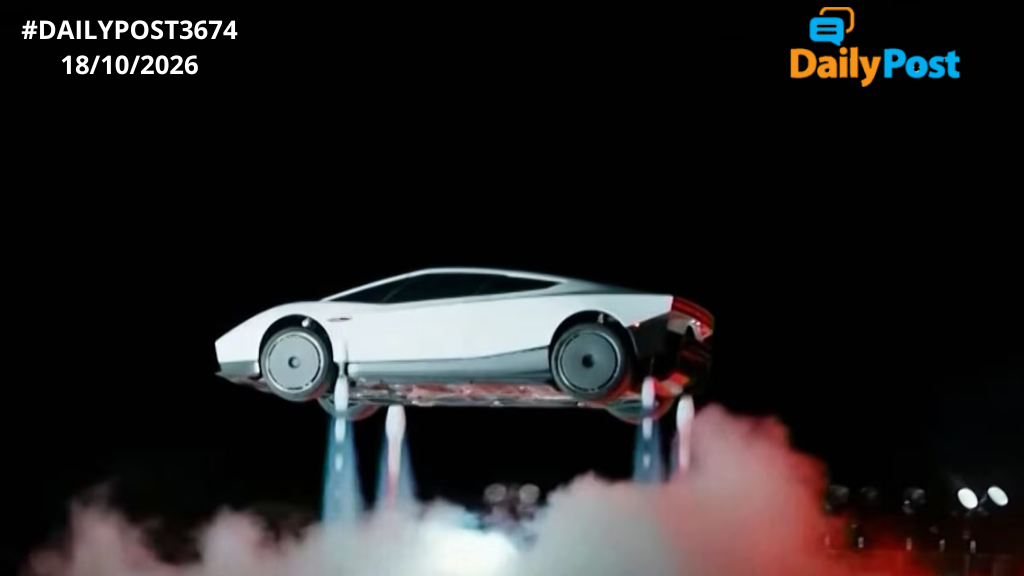
Tesla’s Roadster began in 2017 as a bold promise: an all-electric supercar that would be faster, longer-range and more advanced than anything else on the road. Elon Musk said deliveries would start in 2020, but the project was repeatedly postponed as Tesla focused on mass-market cars, factories and newer technologies. The second-generation Roadster therefore became one of the company’s most famous “coming soon” products.
After nearly nine years, Tesla finally showed a working prototype at SpaceX’s test facility in McGregor, Texas, on October 15, 2026. The two-seater drove up an inverted ramp, became briefly airborne, spun in mid-air and landed safely. It then used cold-gas thrusters to hop over five Tesla vehicles and perform a corkscrew. The stunt was spectacular, but it was still a controlled prototype demonstration, not proof of a road-ready flying car.
The car’s most unusual feature is its SpaceX-inspired thruster system: ten nozzles powered by 600 litres of rechargeable compressed air, which help lift, rotate and stabilise the vehicle briefly. Tesla plans a road-ready Performance version, a Thrust version with booster-assisted acceleration, and an invite-only Rocket version with all ten thrusters. It says production should begin in 2028, with a $250,000 reservation for the Thrust version. The final price, delivery schedule and complete specifications remain unclear.
The biggest hurdles are no longer just engineering: Tesla must prove the car is safe, durable, affordable to build and legally usable on public roads. The flying version may never receive ordinary road approval, and regulators have not outlined a clear certification route for its airborne features. Tesla must now turn a dramatic demonstration into tested production cars, approvals, deliveries and a dependable supply chain. Otherwise, 2028 could become another delayed deadline.
THE ROADSTER HAS SHOWN IT CAN LEAP; NOW TESLA MUST PROVE IT CAN LAND IN SHOWROOMS.
Sanjay Sahay
Have a nice evening.